









By default, Academy course URLs follow WordPress’s standard permalink pattern, but you can customize the URL structure for courses, course categories, and course tags to better match your site’s branding or SEO strategy — all from the familiar WordPress Permalinks screen.
How to access
1.Go to Settings > Permalinks in your WordPress admin (Academy adds its own section to this native WordPress screen, so there’s no separate Academy menu item for it).
2.In the Permalink structure, select Post name.
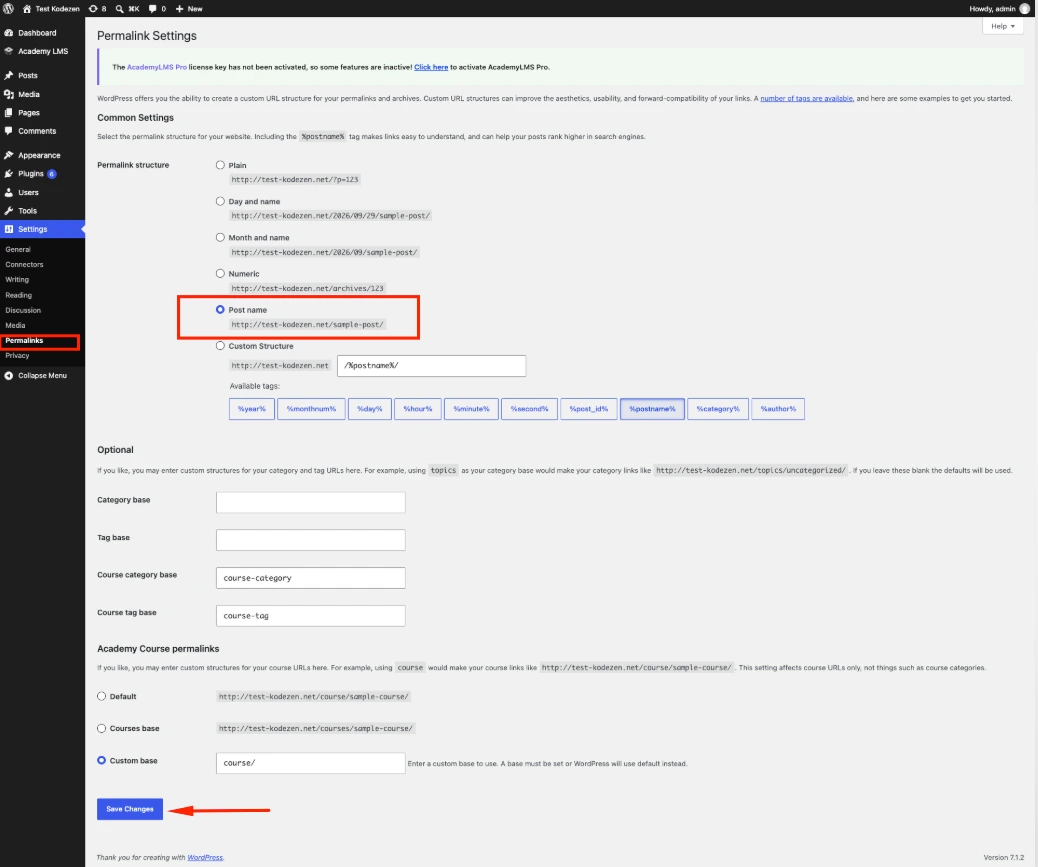
1.Scroll down to the Academy Course permalinks section near the bottom of the page.
2.Under Course Base, choose one of the built-in options, or select Custom base and type your own slug:
Default — courses resolve as ?course=sample-course.
Courses base — courses are nested under your Courses page slug, e.g. /courses/sample-course/.
Custom base — enter any slug you like, e.g. class for /class/sample-course/.
1.Fill in Course category base and Course tag base if you want custom slugs for the course-category and course-tag taxonomy archives instead of the defaults.
2.Click Save Changes at the bottom of the page.
Field breakdown
Course Base — the URL pattern used for single course pages. Choosing Custom base enables a text field where you type the exact base, e.g. course or class.
Course category base — the slug prefix used for course category archive URLs (defaults to course-category).
Course tag base — the slug prefix used for course tag archive URLs (defaults to course-tag).
This setting affects course URLs only — it does not change the slugs of lessons, quizzes, or other curriculum content, which follow the course’s own permalink automatically (e.g. /course/sample-course/lesson/lesson-name/).
After saving, WordPress flushes its rewrite rules automatically, so new course URLs take effect immediately — no need to visit any other screen.