








Is online learning really the future of education? Or is it just a trend that spiked during the pandemic and will fade back to normal?
If you’re planning to build and sell online courses, this is the question that matters most. You don’t want to spend months building courses for a model that has already peaked.
We build Academy LMS, so we work with course creators every day and watch what makes their courses succeed or fail. Here’s our honest answer: the growth is real, and it is not slowing down. But most online courses still fail at the one thing that counts, which is getting learners to actually finish.
So yes, online learning is the future. The catch is that only well-built courses will win.
In this guide, we’ll show you what the 2026 data says, why online learning works so well for course creators, and how to build a course that learners actually complete.
Quick Answer: Is online learning the future of education?
The Numbers Behind Online Learning’s Growth
We’ve watched this shift happen in real time. 300 million people now learn online worldwide (Statista, 2024). That covers everything from short skill courses to full degree programs.
The 2020 pandemic pushed 1.5 billion students to remote learning almost overnight (UNESCO, 2020). Most schools kept their online options after restrictions ended. The demand simply stayed.
Higher education tells the same story. 7.1 million US students were enrolled in online degree programs in 2022, up from 3.1 million in 2012 (NCES, 2023). That’s a 129% jump in ten years.
This is the pattern we see everywhere. Once learners get a format that fits around their job and their life, they don’t go back.
Does Online Learning Actually Work?
Yes, but with one condition. The Research Institute of America found online learners retain 25 to 60% more material than classroom learners. That only holds when the content is well-designed. Passive video with no structure or interaction never gets close.
The corporate numbers back this up. eLearning Industry data shows 77% of US companies now use online learning as their primary training method. They report training costs 40 to 60% lower than classroom programs.
So the format works. What separates a course that works from one that doesn’t is the design behind it.
What Online Learning Makes Possible for Course Creators
This is where online learning stops being a classroom replacement and becomes something better. It gives course creators four things a physical classroom never could.
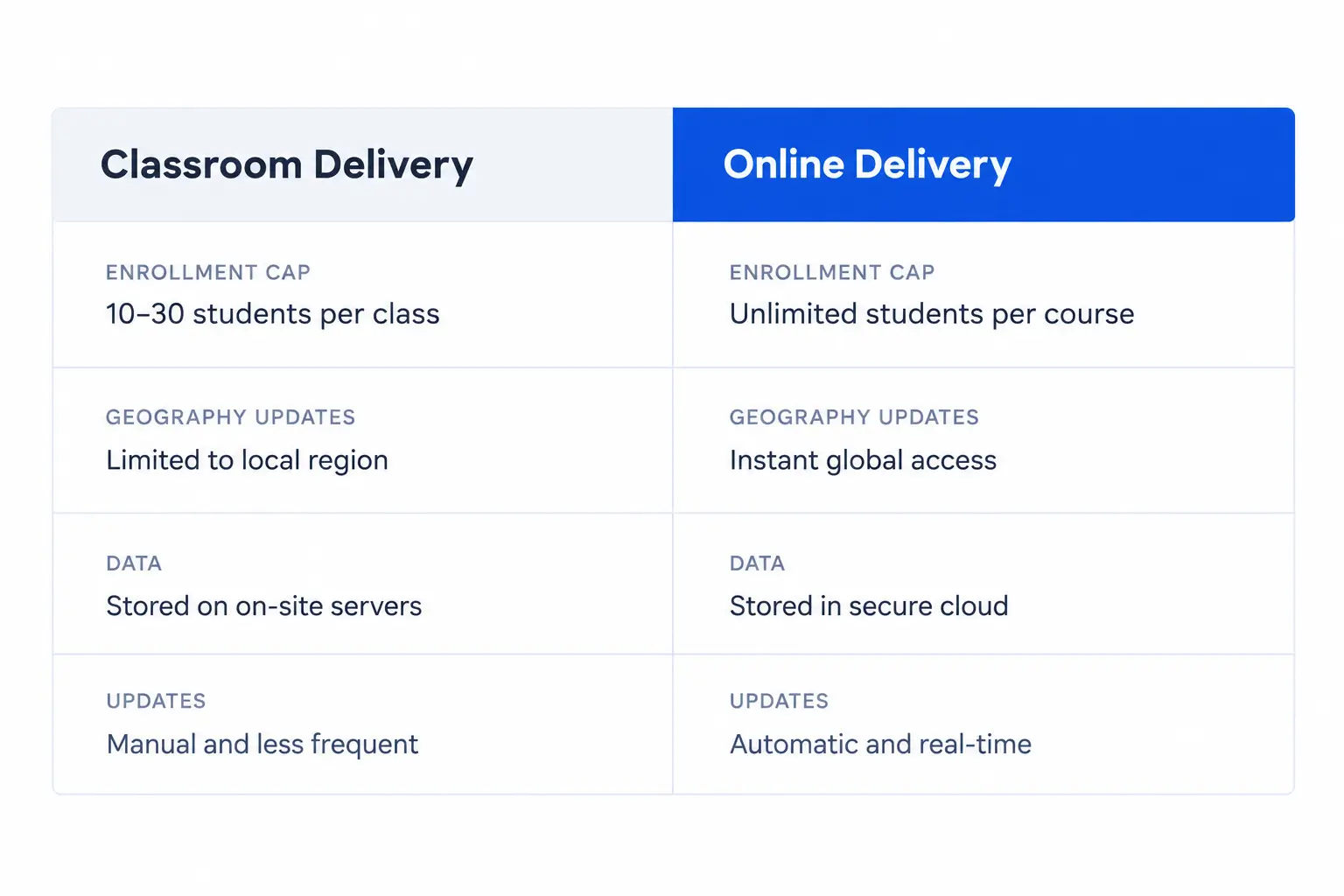
Scale without the extra cost. A classroom caps you at room size and your own teaching hours. An online course has no cap, so you can serve 10 learners or 10,000 with the same content. Each new learner costs you almost nothing.
No geographic limit. A niche topic that couldn’t fill a room in one city can fill a course from learners in 50 countries. You teach once, and anyone, anywhere, can enroll.
Content you can fix anytime. A classroom course is locked the moment it starts. An online lesson can be improved between one learner finishing and the next one starting, so your course gets better over time instead of going stale.
Data on every learner. Online delivery shows you exactly where learners drop off, down to the lesson, the minute, and the quiz question. That’s the data you need to fix the most common eLearning mistakes that kill completion rates before they cost you more students.
Where Online Learning Still Falls Short
We’ll be honest about this part, because most articles skip it. Online learning has real weak spots, and three of them hit every serious course creator.
Completion rates are low. Mirasee data puts average tech course completion at just 34%. Two out of three learners who start never finish. The courses stuck in that 66% usually have no re-engagement plan, no progress checkpoints, and nothing holding learners accountable.
There’s no built-in accountability. A classroom gives you a room, a schedule, and other people watching. Online learning strips all of that away. You can rebuild it with cohorts, peer check-ins, and live sessions, but only if you design them in from the start.
Mobile breaks weak courses. 67% of learners now access courses on their phones (Mirasee, 2024). A course built for desktop, with tiny buttons and video that won’t resize, loses those learners before the first lesson ends.
Related: The top eLearning trends shaping 2026 now make mobile-first design a baseline requirement for every new course.
Why Hybrid Is the Real Future of Education
Here’s the part most “future of education” articles get wrong. They frame it as online versus classroom, winner takes all. That’s not what we see happening.
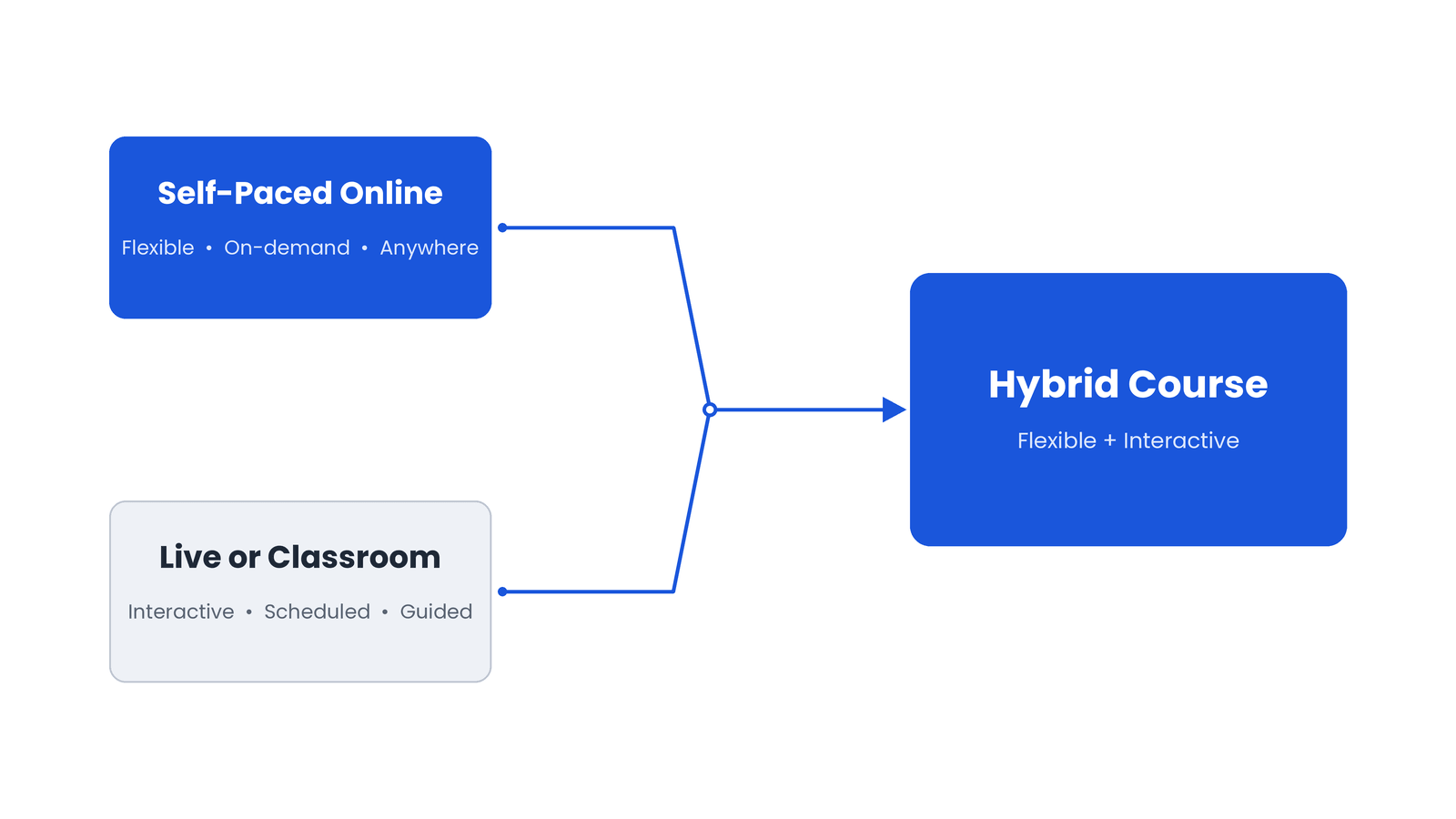
The future is hybrid. Learners want the flexibility of online with some of the structure and human contact of a classroom. The programs growing fastest right now blend both.
Traditional classrooms still win at a few things: hands-on practice, live discussion, and the accountability of showing up. Online wins at flexibility, scale, and cost. Hybrid takes the strong half of each. We break down the full online-versus-classroom question in is online education better than traditional?
For course creators, this is good news. You don’t have to pick a side. The highest-completion programs we see pair self-paced lessons with live touchpoints, like a weekly live Q&A, a cohort that moves together, or office hours on a schedule.
Build the self-paced core once with a structured Academy LMS course builder flow, then add the live layer on top. The self-paced part gives learners flexibility. The live part gives them the accountability that drives completion up.
And From the Learner’s Side?
Learners aren’t asking for pure online either. The same flexibility that pulled them toward online is also what makes rigid, self-paced-only courses easy to abandon.
The completion data tells the rest of the story. Courses that hold learners add live checkpoints and cohorts. Flexibility gets learners in the door. Human contact gets them to the finish line. A course that offers both is the model worth building for.
How to Build an Online Course That Actually Performs
This is the part we know best, because it’s the exact problem we built Academy LMS to solve. Good content alone won’t give you strong completion. Three things will.
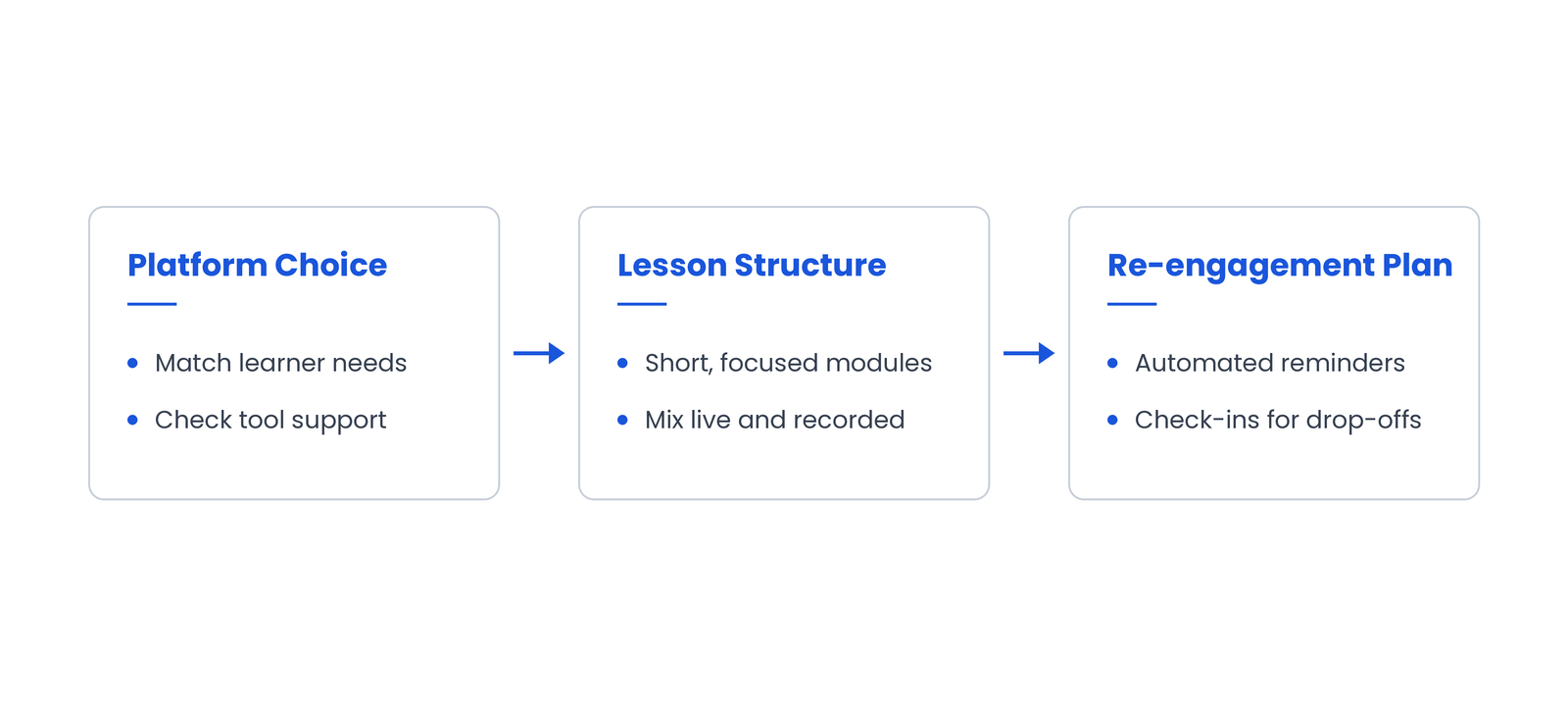
Choose the right platform first. Your learning management system sets the hard limits on what your course can do. A platform that only handles linear navigation can’t run branching scenarios. One with weak mobile rendering loses that 67% of learners at the door.
Before you pick anything, write down five non-negotiables: assessment type, media support, mobile behavior, reporting depth, and pricing model. The best LMS plugins for WordPress compared and our guide to the best free LMS plugin for WordPress both walk through these.
Here’s how Academy LMS handles each one. It’s built for WordPress on a custom database architecture that keeps course data out of the wp_posts table, so your pages stay fast even with thousands of learners enrolled. The Academy LMS course builder creates structured, multi-section courses without any code, so you launch faster. The Academy LMS quiz builder supports scenario-based questions, so you can test whether learners can actually apply a skill instead of just recalling it.
Build lessons that fight dropout. Keep every lesson to one concept. Anything past ten minutes starts losing people to overload. Add one interaction every five minutes, whether that’s a quiz question, a reflection prompt, or a scenario choice, so learners stay active instead of zoning out.
Plan re-engagement before you launch. A learner who hasn’t logged in for three days is already leaving. Set up automated inactivity emails, cohort checkpoints, and completion rewards like certificates or next-course access. Together, these push completion well above the 34% average.
On cost, check Academy LMS pricing before you commit to anything per-learner. Fixed pricing keeps your costs flat as you grow, while per-learner billing gets expensive at exactly the moment your course takes off.
Which move should you make first?
Frequently Asked Questions
Is online learning the future of education?
Yes, for a large and growing share of it. 77% of US companies already use online learning as their primary training method, and over 300 million people learn online worldwide (Statista, 2024). With the market heading toward $1 trillion by 2028, online delivery is on track to become the default rather than the alternative.
What percentage of students learn online?
7.1 million US students were enrolled in online degree programs in 2022, up from 3.1 million in 2012 (NCES, 2023). That’s a 129% increase in ten years. In corporate training the share is even higher, since most companies now default to online for skill development.
What are the advantages of online learning for course creators?
There are four big ones: unlimited scale, global reach, content you can update anytime, and data on every learner. No classroom gives you all four. One online course can serve thousands of learners in any country at a cost that barely moves as you grow.
Why do online courses have low completion rates?
Most courses launch with no completion strategy. No inactivity triggers, no checkpoints, no accountability, so learners quietly drop off when life gets busy. Completion above 65% is very achievable, but it takes automated re-engagement, milestone rewards, and cohort structure. Good content on its own won’t get you there.
Is online learning better than traditional classroom learning?
For retention, online wins when the content is well-designed, with 25 to 60% better retention than classroom delivery (Research Institute of America). For hands-on skills and live feedback, the classroom still holds an edge. We break the full comparison down in Is online education better than traditional?
What skills do course creators need to build effective online courses?
Three, in this order: audience analysis, instructional design, and engagement strategy. Knowing exactly who you teach and what problem they need solved matters more than fancy production. One concept per lesson, one interaction every five minutes, and a re-engagement plan before launch closes most of the gap between courses that work and courses that don’t.
How does mobile design affect online course completion?
A lot. 67% of online learners use their phones (Mirasee, 2024). A course with desktop-only video, tiny tap targets, or layouts that won’t resize loses those learners before the first module ends. The eLearning trends shaping 2026 treat mobile-first design as a hard requirement now.
What is the best platform for building an online course on WordPress?
It depends on your assessment type, media needs, mobile behavior, reporting depth, and pricing model. The best LMS plugins for WordPress compared rates each platform across those criteria. For high-enrollment WordPress courses, we built Academy LMS on a custom database architecture that keeps course data out of wp_posts, so it loads faster at scale than plugins using the default WordPress tables.
We hope this helped you see where online learning is headed and, more importantly, how to build for it. The format is winning, but the courses that win inside it are the ones designed for completion from day one.
When you’re ready to build, take a look at the most common eLearning mistakes that kill completion rates and the top eLearning trends shaping 2026 so you start ahead of most course creators.