








Everything you need to know about both paths — cost, flexibility, career outcomes, technology, and how to choose what’s right for you in 2026.
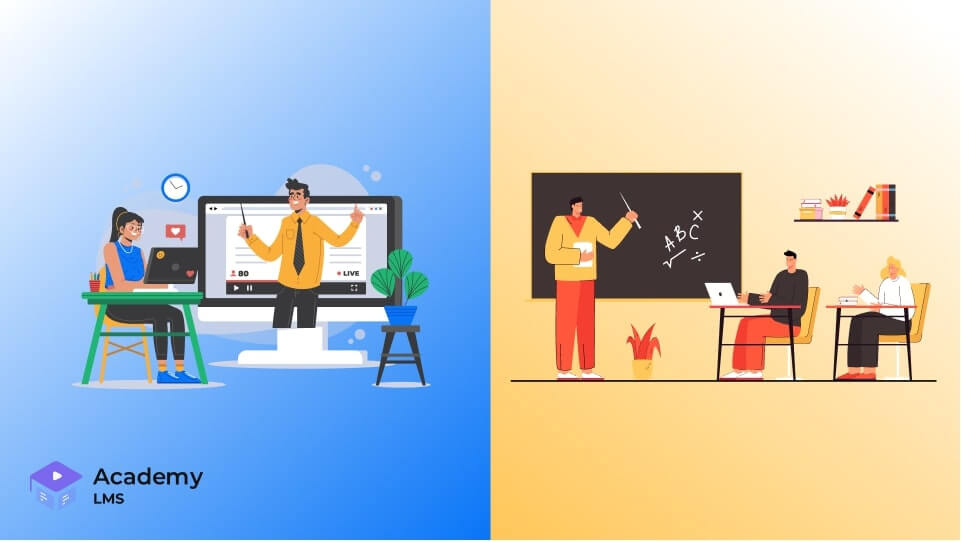
In 2026, the question is no longer “is online learning legitimate?” — it’s “which learning model fits your life, goals, and field?” Both paths have matured dramatically. This guide breaks down every major dimension of online teaching and classroom learning so you can make an informed, confident decision.
1. What is Online vs. Traditional Learning?
Online learning (also called e-learning or distance education) delivers instruction entirely or primarily through the internet. Students access coursework, lectures, and assessments via platforms like Coursera, edX, Canvas, or institutional portals — from anywhere in the world, at any time.
Traditional learning refers to the classic in-person classroom model: structured schedules, physical campus attendance, face-to-face instruction, and direct peer-to-peer interaction. This has been the dominant model for centuries.
A third category — hybrid learning — blends both approaches and has surged in popularity since 2020. Many institutions now consider blended learning the standard, with over 60% of universities globally offering hybrid tracks as of 2025.
| KEY INSIGHT The global e-learning market is projected to reach $680 billion by 2027, up from $399 billion in 2022 — reflecting a fundamental shift in how people access education worldwide. |
2. Cost Comparison
Cost is one of the most decisive factors when choosing between learning modes. Online education consistently offers a lower financial burden, but the gap varies significantly by program type and institution.
|
$31K — Average annual out-of-state tuition and fees at U.S. public four-year institutions (2025–26) |
$7K — Annual cost of an accredited online degree program |
$0Cost of thousands of free courses on Coursera, edX, Khan Academy |
72%Of online learners cite lower cost as primary reason for choosing e-learning |
What does traditional learning cost beyond tuition?
Traditional students carry significant hidden costs: on-campus housing ($10,000–$18,000/year), meal plans ($4,000–$6,000/year), commuting, textbooks, and social activities. These can push the total annual cost well above $50,000 at private institutions.
Online learners typically eliminate housing and commuting costs entirely. Most digital textbooks and resources are included in the course fee or available free through open-access libraries.
| IMPORTANT CAVEAT Free or cheap online courses vary enormously in quality and accreditation, impacting access to education. Always verify that an online program is accredited by a recognized body before enrolling, especially if you plan to use the credential for employment or postgraduate study. |
3. Flexibility & Schedule
This is where online learning has its strongest advantage, offering unique benefits of online courses. For working adults, parents, caregivers, and people in different time zones, schedule flexibility for online discussion is not a luxury — it is a necessity.
|
Factor |
Online Learning |
Traditional Learning |
|
Schedule |
Fully flexible; most courses are asynchronous |
Fixed timetable; mandatory attendance |
|
Location |
Learn from anywhere with an internet connection, thanks to online learning offers. |
Must be near campus |
|
Pace |
Self-paced or structured deadlines |
Instructor-led fixed pace |
|
Work compatibility with learning online is increasingly important. |
Easy to combine with full-time work, highlighting the benefits of online learning. |
Difficult unless part-time enrollment |
|
Interruptions in online teaching can affect the delivery of course material. |
Can pause and resume learning online anytime. |
Fixed semester structure; hard to pause, which is one of the cons of online learning. |
|
Geographic access is one of the key benefits of online learning. |
Global — accessible in 190+ countries |
Limited to local or emigrant students |
“The single greatest equalizer in modern education is the ability to learn from anywhere. Online learning has democratized access to education and world-class instruction.
— Dr. Amara Osei, Global Education Report, 2025
4. Learning Quality & Outcomes
The most important question for any learner: will you actually learn as much? The research is more nuanced than either camp admits.
What research says about online learning effectiveness
Multiple studies from MIT, Stanford, and the US Department of Education have found that online learners retain 25–60% more material than classroom-based learners — primarily because self-paced learning allows for revisiting content, and video lectures can be paused, rewound, and replayed. Classroom lectures cannot.
However, retention drops significantly without external accountability in an online learning environment. Students who self-enroll in MOOCs without structured cohorts complete only 5–15% of courses. This reveals that completion and learning quality in traditional classroom settings are highly dependent on the learner’s own motivation and discipline.
Where traditional learning still wins
Hands-on, applied disciplines present a genuine challenge for online formats. Medical students need cadavers and clinical rotations. Engineering students need labs, but they can also benefit from courses online that complement their hands-on experience. Culinary students need kitchens. For these fields, traditional learning remains essential — online components are supplemental, not substitutional, to quality education.
Direct instructor feedback in real-time is another area where traditional classrooms excel. Complex questions that benefit from dialogue, debate, and live Q&A are harder to replicate asynchronously, though AI tutoring tools are rapidly closing this gap.
| 2026 DEVELOPMENT AI-powered adaptive learning systems can now personalize coursework in real time, adjusting difficulty and content based on each student’s performance — a capability no traditional classroom instructor can match at scale. |
5. Social Interaction & Networking
College is not just about grades — it is about who you meet. Traditional campuses offer irreplaceable spontaneous interactions: study groups that become friendships, professors who become mentors, chance hallway conversations that lead to career opportunities.
Online learning has made enormous progress in community building through forums, Discord servers, virtual study groups, and live cohort sessions — but the serendipity and depth of on-campus relationships remain difficult to replicate. A 2024 LinkedIn survey found that 78% of professionals said their most valuable career connection came from their college campus, not an online community.
Networking in a hybrid world
The good news: the professional world has also shifted towards valuing skills acquired through successful online education. Remote work and distributed teams mean that the ability to build professional relationships online is now a core career skill, especially in virtual education. Students who master online networking are often better prepared for the modern workplace than those who only networked in person, showcasing the benefits of online learning.
| LONELINESS RISK Studies show online learners are significantly more likely to experience academic isolation, which directly impacts motivation and completion rates. Building a deliberate social structure — virtual study groups, Discord communities, or alumni networks — is critical for online students. |
6. Technology & AI Tools in 2026
Technology has transformed both models, but its impact on online learning has been more dramatic and faster-moving than on in-person learning.
Key technologies shaping online learning in 2026
AI tutors provide 24/7 personalized support. Platforms like Khanmigo and Coursera’s AI assistant can answer questions, explain concepts differently, and track learning gaps in real time. Adaptive assessments adjust test difficulty based on performance. VR and AR labs now allow medical and engineering students to practice procedures in immersive simulations, enhancing their learning opportunities.
Traditional institutions are also integrating these tools, but adoption is slower due to infrastructure costs, faculty training requirements, and institutional inertia. Many top universities still rely on lecture-hall teaching as the primary delivery model.
|
83%Many online learning platforms now offer AI-assisted tutoring, enhancing the quality education available in 2025. |
41%Of traditional universities have integrated AI tools into core curriculum |
3×Faster completion time for adaptive online courses vs. fixed-pace classroom |
7. Career Outcomes & Employer Perception
This is the make-or-break question for most learners’ learning style. Does the credential you earn actually open doors?
The answer depends heavily on your field. In law, medicine, and licensed engineering, traditional accredited degrees remain non-negotiable. Licensing bodies require specific institutional credentials, and employers in these sectors actively screen for them, making it crucial to understand the pros and cons of online education.
In technology, business, marketing, design, and creative fields, the shift towards successful online education has been dramatic. A 2025 Stack Overflow survey found that 62% of hiring managers in tech weigh portfolio and demonstrable skills more heavily than the type of institution attended. Certificates from Google, AWS, Salesforce, or Meta are now accepted as primary credentials at thousands of companies.
Salary outcomes
Traditional degree holders still earn more on average overall — but the gap is narrowing in the context of online education vs traditional education. When controlled for field and years of experience, online graduates in tech roles earn within 8% of traditional graduates, down from a 24% gap a decade ago.
| KEY TAKEAWAY The prestige of the institution matters more than the delivery mode. An online degree from MIT or Harvard carries more weight than an in-person degree from an unaccredited local college. Always research institutional reputation first. |
8. Pros & Cons Summary
Online Learning
|
✦ ADVANTAGES OF ONLINE LEARNING |
✦ DISADVANTAGES |
|
Lower cost overall |
− Requires high self-discipline |
|
Full schedule flexibility |
− Lower completion rates without structure |
|
Accessible from anywhere globally |
− Limited hands-on lab experience |
|
Self-paced learning options |
− Weaker spontaneous networking |
|
AI-powered personalized tutoring |
− Risk of isolation and burnout |
|
Wide variety of specialized courses |
− Variable quality and accreditation can affect the learning experience. |
|
Compatible with full-time work and flexible online class options. |
− Tech dependency (internet, devices) |
|
Immediate content updates |
− Employer bias in some sectors |
Traditional Learning
|
✦ ADVANTAGES |
✦ DISADVANTAGES |
|
Structured, accountable environment |
− Significantly higher cost |
|
With direct access to professors, students can enhance their learning experience in traditional classes and online school. |
− Fixed schedule — limited flexibility in a distance learning format |
|
Rich social and networking life, enhanced through virtual education environments. |
− Geographic restrictions can limit accessibility for some learners. |
|
Hands-on labs and facilities are essential, but the benefits of online learning can also provide valuable supplementary resources. |
− Slower to update curriculum |
|
Widely recognized credentials |
− One-size-fits-all pacing |
|
Immersive campus experience |
− Commuting time and cost |
|
Easier for struggling learners |
− Student debt burden |
|
Strong alumni networks can provide valuable connections for students transitioning from traditional classes to online learning. |
− Not always AI-enabled |
9. Which Is Better for You?
There is no universal answer — but there are clear patterns based on your situation:
Choose online learning if you…
• Are already working and cannot pause your career
• Have family or caregiving responsibilities
• Live in a region without quality local institutions
• Are pursuing technology, digital marketing, data science, or creative fields
• Want to acquire a specific skill quickly rather than complete a full degree
• Have strong self-motivation and can maintain discipline independently
Choose traditional learning if you…
• Are pursuing medicine, law, licensed engineering, or another regulated profession
• Are 17–22 years old and value the social and developmental experience of campus life
• Need structured accountability and direct human support to stay on track, which can be a challenge in an online environment.
• Want access to on-campus research labs, clinical placements, or specialized facilities
• Are entering a field where prestigious institutional credentials still open doors
Consider hybrid learning if you…
• Want the best of both worlds
• Most universities now offer hybrid tracks that let you attend key classes in person while completing coursework online
• This is increasingly considered the gold standard model for adult learners in an online learning environment.
| OUR VERDICT ON THE BENEFITS OF ONLINE LEARNING The question isn’t online vs. traditional — it’s accredited vs. unaccredited, and matched to your career path. Both models work when quality is high and the credential is relevant to your goals. Focus on institutional reputation, accreditation, and program outcomes — not the delivery format — and you will make the right choice. |
10. Frequently Asked Questions
Is online learning as effective as traditional learning?
Research shows online learning can be equally or more effective when students are self-motivated. Studies indicate online learners retain 25–60% more material than classroom-based learners due to self-paced control. However, completion rates are lower for self-directed learners without structured cohorts.
Which is cheaper: online learning or traditional classes?
Online learning is significantly cheaper on average. Traditional 4-year university degrees in the US can cost $30,000–$200,000+, while online degrees from accredited institutions range from $5,000–$25,000. Free courses are widely available via platforms like Coursera, edX, and Khan Academy, though these may not carry formal credentials.
What are the biggest disadvantages of online learning?
The main disadvantages include lack of face-to-face social interaction, need for strong self-discipline, limited hands-on or lab experience, and potential employer bias toward traditional degrees in regulated fields like medicine, law, and engineering.
Which type of learning is better for career outcomes?
It depends on the field. Traditional degrees hold more weight in medicine, law, and engineering. For technology, business, and creative fields, online certifications and portfolios are increasingly valued — especially when combined with real-world projects and a strong portfolio that can be showcased in an online environment.
What is hybrid learning and is it a good option?
Hybrid learning combines in-person classes and online instruction. Students may attend campus for labs, seminars, and social events while completing lectures and coursework online. It is widely considered the most adaptable model for working adults and is now offered by the majority of accredited universities globally.
Do employers prefer traditional degrees over online degrees?
Preferences vary by industry, particularly regarding learning outcomes. In technology and business, employer bias toward traditional degrees has significantly decreased — most hiring managers focus on skills, portfolio, and experience gained through quality education. In regulated professions (medicine, law, architecture), traditional degrees from accredited institutions remain essential for licensing and employment, even in a virtual education context.