







Managing training online and managing website content look similar from a distance. Both need somewhere to store files. Both have users who log in. Both involve publishing content to an audience.
But they solve completely different problems. Trying to run online courses through a plain CMS is like trying to manage a warehouse with a filing cabinet. It holds things, but it was never built for that job.
This guide explains what separates an LMS from a CMS, when each one is the right call, and what to do if you need both.
Quick Answer: LMS vs CMS
What Is an LMS?
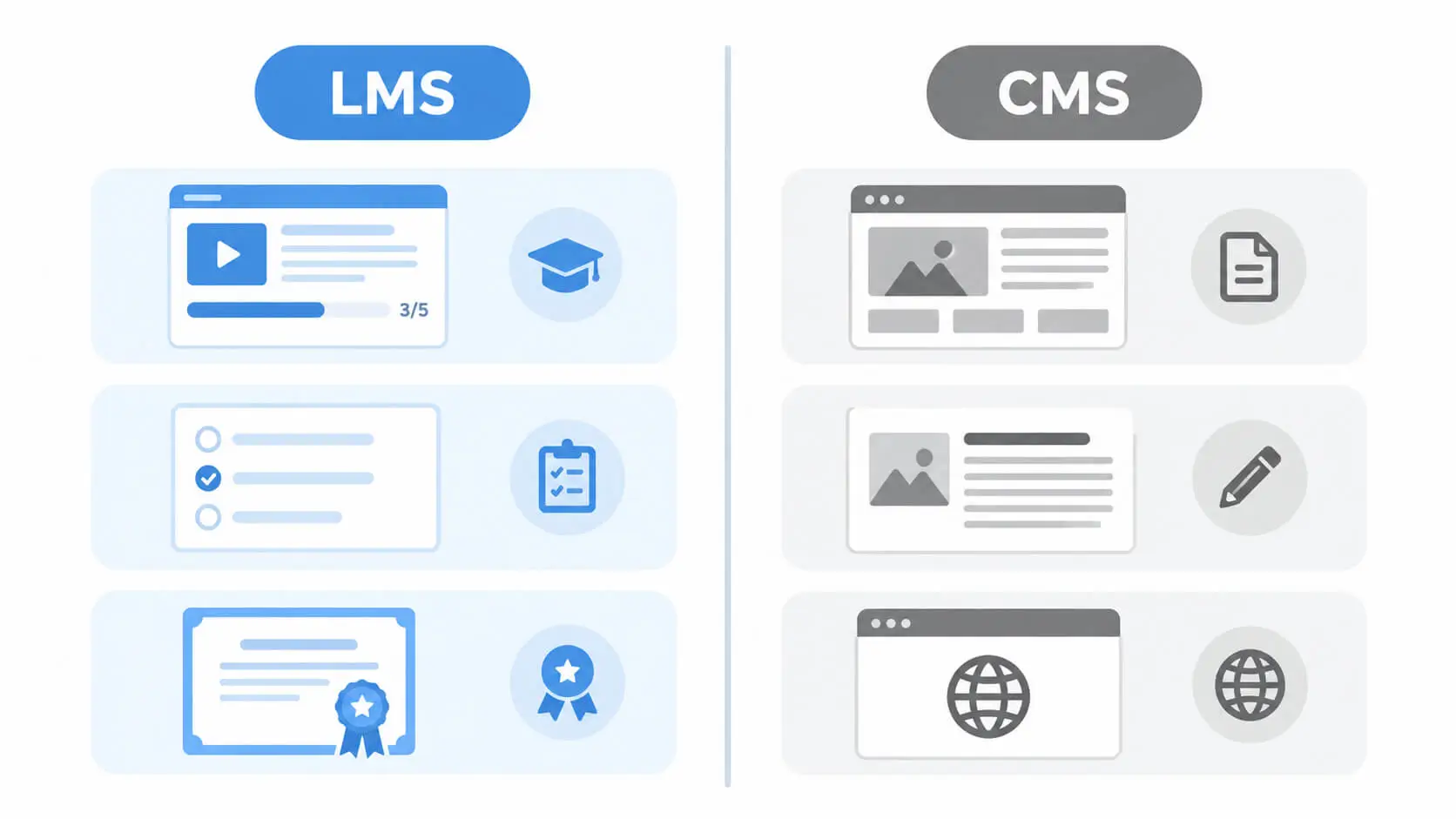
An LMS, or Learning Management System, is software that manages the full lifecycle of training: building courses, enrolling learners, delivering content, running assessments, and tracking every result. For a full breakdown, see our guide on what is a learning management system.
The key word is “tracking.” An LMS knows who started a course, who finished it, what score they got on a quiz, and whether they earned a certificate. A manager or admin can pull that data at any time. That measurability is what separates an LMS from every other content tool.
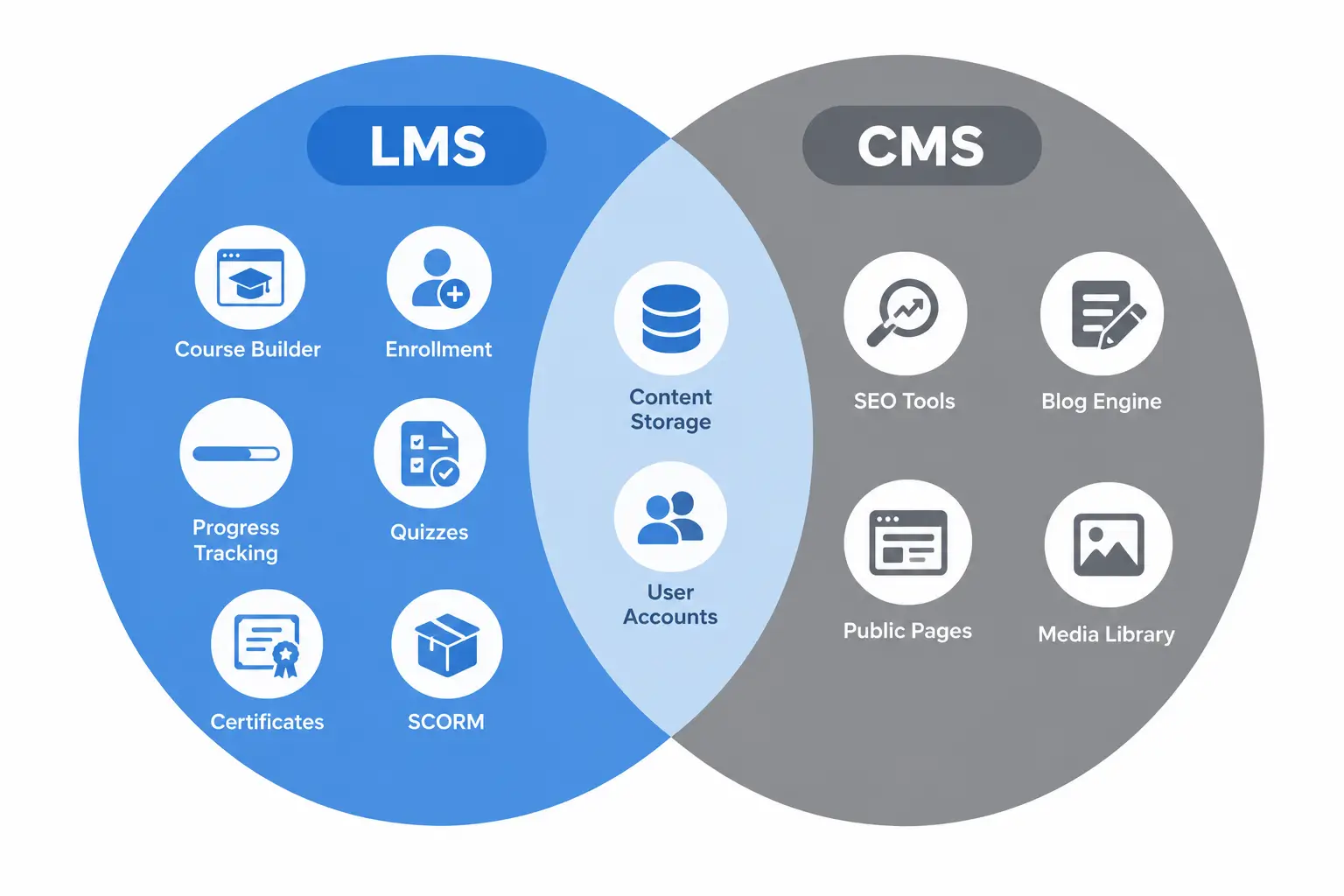
Standard LMS features include a course builder, learner enrollment, quiz and assessment tools, progress tracking dashboards, completion certificates, and SCORM compatibility for importing third-party course packages.
What Is a CMS?
A CMS, or Content Management System, is software for building and managing website content without writing code. You create pages, write posts, upload media, and publish everything to a public-facing site. WordPress powers around 43% of all websites, making it the most widely used CMS by far.
A CMS organizes content by type: pages, posts, categories, and tags. It serves that content to anyone who visits the URL. There is no concept of enrollment, no quiz engine, no progress tracking, and no certificate generation. A visitor reads a page and moves on. The CMS does not know or care what they understood.
LMS vs CMS: The Core Difference
The simplest way to understand it: a CMS broadcasts content to everyone. An LMS delivers structured learning to specific people and measures the result.
Here is a side-by-side comparison:
|
Feature |
LMS |
CMS |
|
Course builder |
✅ Built in |
❌ Not available |
|
Learner enrollment |
✅ Individual accounts with access control |
❌ Public access only |
|
Progress tracking |
✅ Per-learner, per-course |
❌ Not available |
|
Quiz and assessments |
✅ Scored, with a grade book |
❌ Not available natively |
|
Completion certificates |
✅ Automated on completion |
❌ Not available |
|
SCORM support |
✅ Industry standard |
❌ Not available |
|
SEO and blogging |
⚠️ Limited |
✅ Built for it |
|
Public content publishing |
⚠️ Limited |
✅ Built for it |
|
User roles |
Learner, instructor, admin |
Editor, author, admin |
|
Best for |
Training managers, course creators |
Websites, blogs, content marketers |
The overlap is narrow. Both store and serve content, and both have user accounts. Everything else differs by design.
What Goes Wrong When You Use a CMS to Run Online Courses
Many course creators start on a plain WordPress site or a website builder like Squarespace and try to run courses through it. The problems are predictable.
No Learner Enrollment or Tracking
Anyone who finds the URL can access your “course” content. You have no way to know who actually started, how far they got, or who dropped off at Module 2. There is no learner dashboard, no admin view, and no record of completion.
No Quiz Scoring
You can embed a third-party quiz plugin, but the results are not tied to course completion. There is no grade book. There is no way to block a learner from progressing until they pass an assessment.
No Completion Certificates
You can design a PDF certificate, but you cannot automate issuing it. Every certificate requires manual work. That is manageable for 10 students. It breaks down completely at 100.
No Enforced Course Sequence
A CMS serves pages. It does not enforce an order. A learner can jump to Module 5 without completing Module 1. For any curriculum that builds on itself, that is a problem you cannot fix with a CMS alone.
Revenue Is Disconnected from Access
A CMS with a payment plugin can take money, but it cannot tie that payment to a specific learner’s access to a specific course with expiry logic, progress tracking, or automatic enrollment. You end up managing this by hand.
The fix is adding an LMS layer — either as a separate platform or, on WordPress, as a plugin that slots into what you already have.
LMS vs CMS vs LCMS: Is There a Third Option?
A Learning Content Management System (LCMS) is a third category worth understanding before you decide.
An LCMS is software built for creating and managing reusable learning content objects. Individual pieces of content are stored in a library and assembled into multiple courses. Where an LMS manages learner delivery and tracking, an LCMS manages content production and version control at scale.
Large L&D teams at corporations or publishers use LCMS tools to manage content libraries across many courses. For most course creators and training managers, an LCMS is overkill. If you are building courses for your own platform, an LMS handles the full workflow.
|
Tool |
Primary job |
Who needs it |
|
CMS |
Publish web content to a public audience |
Websites, blogs, content marketers |
|
LMS |
Deliver and track structured training |
Trainers, educators, course creators |
|
LCMS |
Author and manage reusable learning objects |
Large L&D teams, publishers, content vendors |
When Does an LMS Beat a CMS?
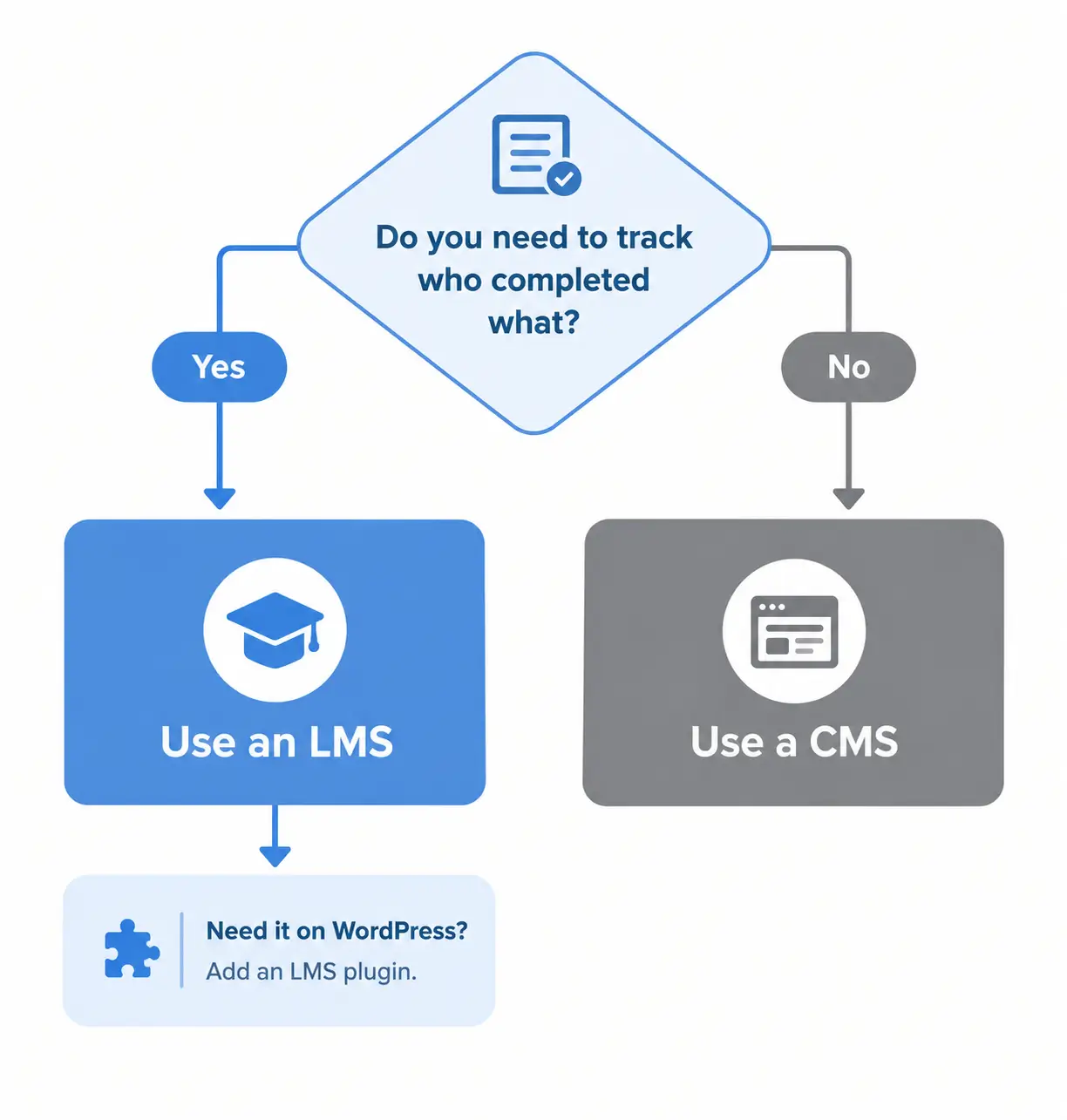
Use an LMS when the outcome of training matters and you need to measure it.
Employee onboarding and compliance. You need documented proof of who completed what and when — not just who had access to a page. An LMS generates that audit trail automatically. See our breakdown of the benefits of online training for employees for what that looks like in practice.
Selling online courses. If you charge per course or per subscription, you need enrollment logic tied to payment, progress tracking per learner, and automatic certificate issuance on completion. None of that is native to a CMS.
Structured curriculum. If the course is designed as a sequence — Module 1 before Module 2, quiz before progressing — you need an LMS to enforce that structure. A CMS cannot do it.
Large organizations. Enterprise training with SSO, multi-tenant architecture, and compliance reporting needs a dedicated LMS. For that scale, see our guide to affordable enterprise learning management systems.
When Does a CMS Beat an LMS?
Use a CMS when your goal is publishing content to a public audience without tracking individual learners.
Marketing content. Blog posts, product pages, and landing pages belong in a CMS. They are public, SEO-indexed, and serve everyone equally. An LMS is not designed for this.
Knowledge bases and documentation. A FAQ hub, help center, or resource library is CMS territory. Readers browse at will with no enrollment needed.
Membership sites without structured learning. If you are paywalling articles or videos but not running a curriculum with quizzes and certificates, a CMS with a membership plugin is the simpler and cheaper option.
WordPress Users: You Already Have a CMS — Here’s How to Add an LMS
WordPress is the world’s most popular CMS. If you already run a WordPress site, you do not need to start over or pay for a separate LMS platform.
Adding Academy LMS as a plugin turns your existing WordPress CMS into a full learning platform. You keep everything already working — your theme, your SEO, your existing pages, your blog — and you add course enrollment, progress tracking, quiz engines, and certificate generation on top of it.
This is the key point for WordPress users: an LMS plugin does not replace your CMS. It extends it. Your blog stays your blog. Your landing pages stay your landing pages. Your courses live inside the same WordPress install, with their own learner dashboard and tracking logic.
Compare that to hosted LMS platforms like Teachable or Thinkific. Those are self-contained LMS tools. You get course delivery, but you leave behind your existing SEO, your theme, and your design flexibility. You end up paying for two platforms and managing two sites. For a full cost breakdown of your options, see our guide on LMS cost and pricing.
For WordPress users who already have a CMS, the question is not “LMS or CMS.” It is “which LMS plugin works best with the CMS I already have?”
Decision Framework
For a full breakdown of what to look for when evaluating platforms, see our guide on how to choose the right LMS.
Frequently Asked Questions
Is an LMS the same as a CMS?
No. An LMS and a CMS solve different problems. A CMS manages and publishes website content for a public audience. An LMS manages the delivery and tracking of structured training for enrolled learners. They can work together, but they are not interchangeable.
Can WordPress be used as an LMS?
WordPress is a CMS by default, but it becomes a full LMS when you add the right plugin. LMS plugins add course builders, learner enrollment, progress tracking, quiz engines, and certificate generation directly inside WordPress. You get both a CMS and an LMS in one platform.
What is SCORM and which tool supports it?
SCORM (Sharable Content Object Reference Model) is a standard format for packaging e-learning courses so they can be imported into any compliant LMS. LMS platforms support SCORM. CMS platforms do not. If you are buying or creating SCORM-packaged courses, you need an LMS.
Can you use a CMS to sell online courses?
You can take payments through a CMS, but you cannot manage enrolled learners, track course progress, enforce course sequences, or issue certificates without LMS functionality added on top. Most course creators who try this end up adding an LMS plugin or switching platforms.
What is an LCMS?
An LCMS (Learning Content Management System) is a tool for building and managing reusable learning content objects. It handles content production and version control at scale. Most individual course creators do not need one. An LMS handles course building and delivery for most use cases.
Do I need both an LMS and a CMS?
Not necessarily. On WordPress, a single LMS plugin covers both. On a hosted LMS platform like Teachable, you may still want a separate blog or marketing site to drive traffic — that would be a CMS. The right answer depends on whether your courses and your marketing content need to live in the same place.
How much does an LMS cost compared to a CMS?
WordPress CMS is free, with hosting starting around $5 to $20 per month. An LMS plugin for WordPress costs $100 to $300 per year. Hosted SaaS LMS platforms range from $59 per month to $500 or more. Enterprise LMS contracts start at $15,000 per year. For the full breakdown, see our LMS cost and pricing guide.