






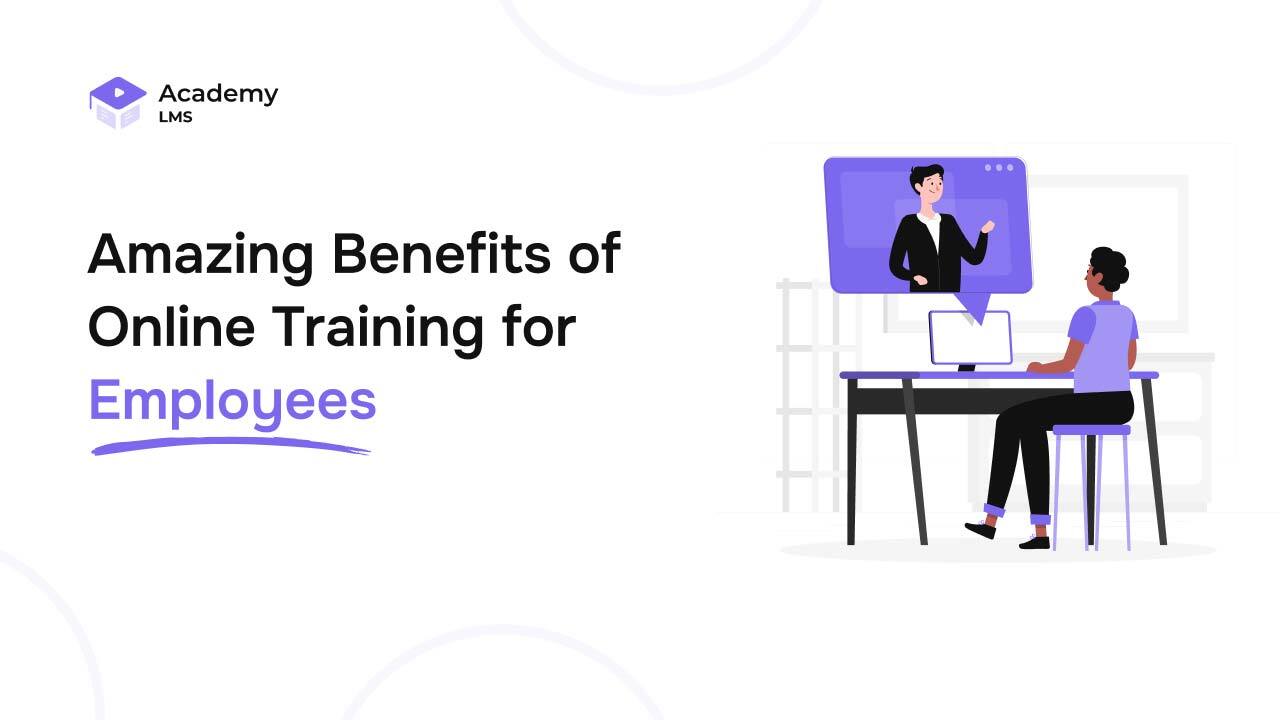

Most training fails before anyone opens a course. It fails during the planning stage, when companies pick the cheapest option that works for one location on one day — not the one that actually works for their whole team.
Online training is not just a cheaper version of in-person training. It solves different problems, and it solves some of them better. According to Gallup research, companies that invest strategically in employee development report 11% greater profitability and are twice as likely to retain their people.
This guide covers 8 specific benefits, what the research actually says about each, and how smaller organizations and WordPress course creators can capture the same results as enterprise L&D teams.
Quick Answer: Benefits of Online Training for Employees
What Is Online Employee Training?
Online employee training is any structured learning delivered through a digital platform — video courses, interactive modules, quizzes, or live virtual sessions — that employees can access from anywhere on any device. For a deeper look at the platforms that power it, see our guide on what is a learning management system.
The key difference from traditional training is that the content, the delivery, and the tracking all happen in one place. An LMS records who started, who finished, what score they got, and whether a certificate was issued — without any manual follow-up from a manager or HR team.
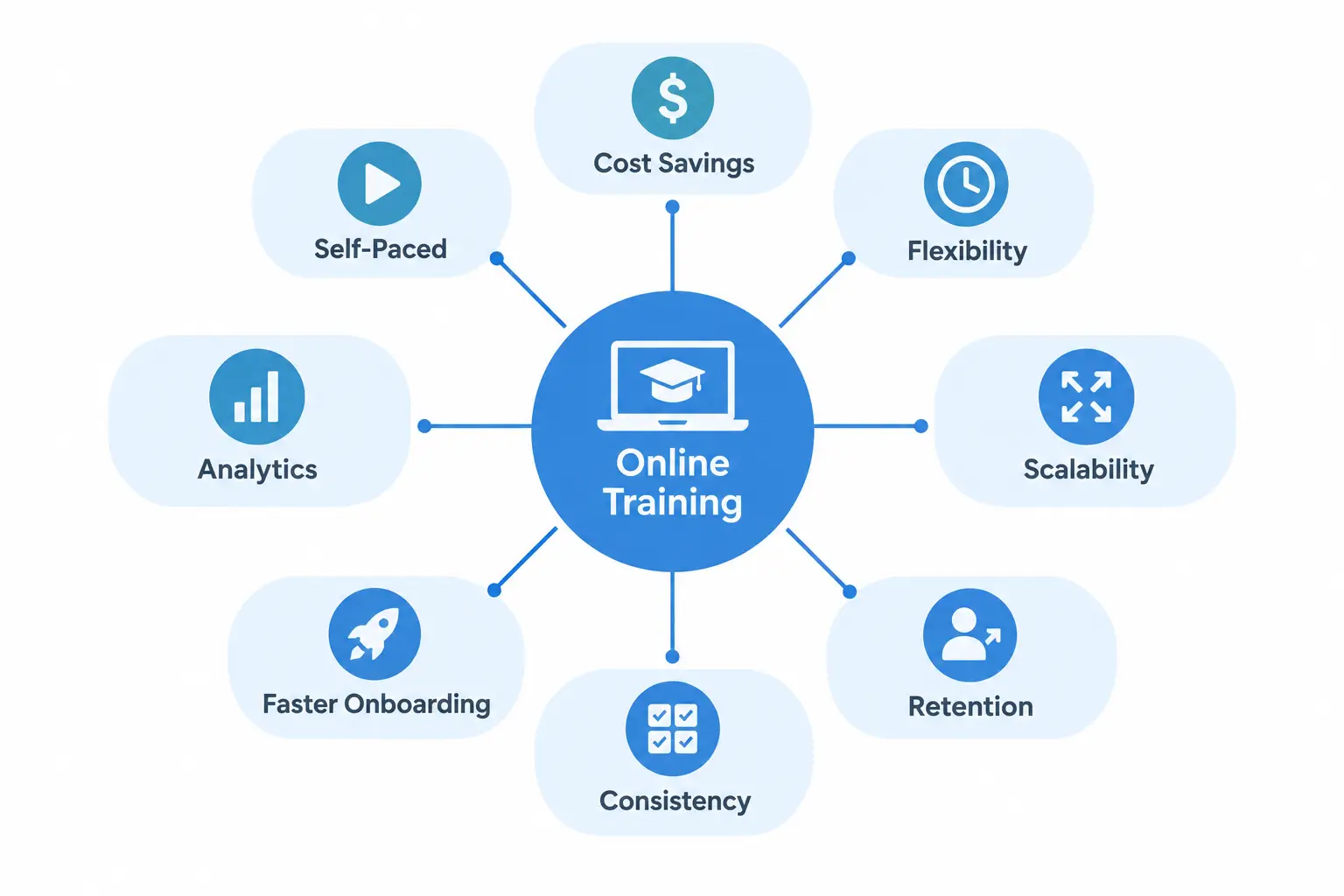
8 Benefits of Online Training for Employees
1. Lower Training Costs Without Cutting Quality
In-person training carries fixed costs that never scale: travel, venue rental, printed materials, and instructor fees for every session. Online training replaces all of that with a one-time content build that runs indefinitely.
Research cited by Forbes shows online learning takes 40 to 60% less time than traditional instructor-led formats. That time difference translates directly into payroll savings — less time pulled away from productive work, fewer facilitators needed per cohort, and no logistical overhead for scheduling rooms or booking travel.
For businesses already on WordPress, an LMS plugin like Academy LMS eliminates the platform licensing cost of a hosted LMS. You pay for the plugin, not a per-seat subscription. For the full cost breakdown, see our LMS cost and pricing guide.
2. Employees Learn at Their Own Pace — and Retain More
A two-hour classroom session delivers everything at once. An employee who does not understand Module 3 cannot pause the instructor and review it later. Online training can.
Self-paced delivery lets learners replay a section, slow down on a difficult concept, and move quickly through content they already know. That flexibility also enables spaced repetition — returning to material over days rather than consuming it all in one sitting. Spaced repetition is one of the most evidence-backed methods for long-term knowledge retention.
The practical result: employees who complete online training are more likely to retain what they learned three weeks later than employees who sat through the same content in a classroom.
3. Training Scales as Your Team Grows
In-person training scales linearly. Double the team, double the training sessions, double the cost. Online training does not work that way.
Once a course is built, adding the next 10, 50, or 500 learners costs almost nothing. The content is the same. The assessments are the same. The certificate criteria are the same. You do not need another instructor, another room, or another flight.
This scalability matters most during growth phases: new office openings, product launches, compliance deadlines, or rapid hiring cycles. An LMS handles all of it from one admin dashboard. For teams growing into enterprise scale, see our guide on affordable enterprise learning management systems.
4. Higher Employee Retention
Gallup research shows organizations that invest strategically in employee development are twice as likely to retain their people. The 2025 LinkedIn Workplace Learning Report found 88% of organizations cite retention as their top concern — and learning and development as their primary response strategy.
The mechanism is straightforward. Employees who feel the company is investing in their growth are less likely to leave for a company that appears to offer more opportunity. Online training makes that investment visible: there are courses to take, skills to develop, and certificates to earn, all on a timeline the employee controls.
For small and mid-size companies that cannot match enterprise salary packages, a clear learning path is one of the most competitive retention tools available.
5. Consistent Training Quality Across All Teams and Locations
When training is delivered by different instructors in different offices, quality varies. One manager emphasizes compliance. Another skips it. One instructor is engaging. Another reads from slides. The result is uneven skills and inconsistent practice across the organization.
Online training solves this with standardization. Every employee watches the same video, takes the same quiz, and passes the same threshold before receiving a certificate. A new hire in one city gets the exact same onboarding experience as a new hire in another. Compliance standards are met uniformly, which matters in regulated industries.
6. Faster Onboarding for New Hires
New employees rarely reach full productivity on day one. They need orientation, compliance training, product knowledge, system walkthroughs, and process documentation — all while trying to absorb a new environment.
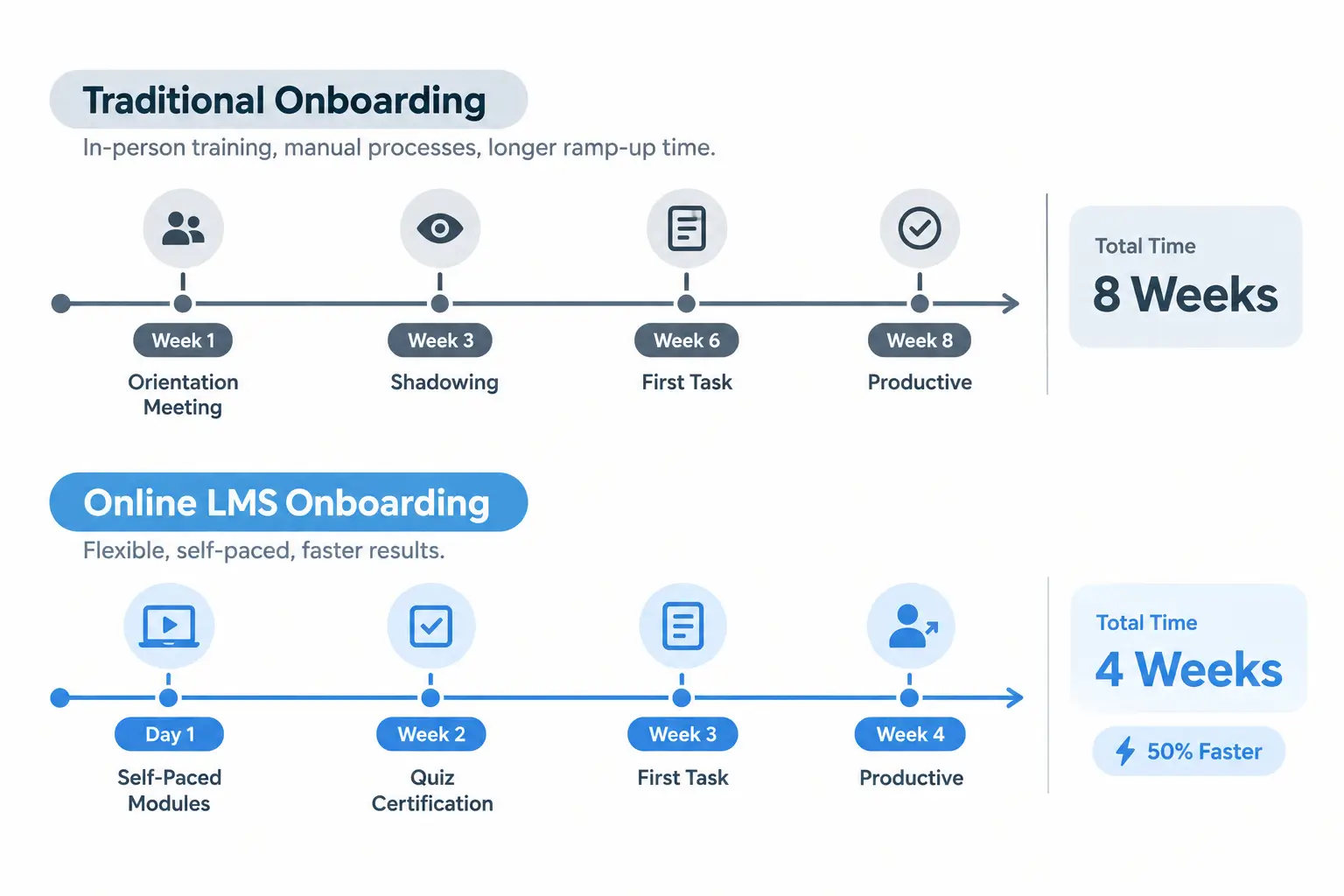
Online training compresses that curve. A structured onboarding course delivers the same information in a controlled sequence: watch this, complete this quiz, move to the next module. Managers do not need to schedule repeated briefings. HR does not chase down completion paperwork. The LMS tracks it all automatically.
The result is a measurable reduction in time-to-competency for new hires, which directly affects how quickly they start contributing to the team.
7. Training Data Shows You What Is — and Is Not — Working
Most in-person training ends with a feedback form and a guess about retention. Online training ends with data.
An LMS records completion rates, quiz scores, time-on-module, and drop-off points. If 40% of learners quit at Module 4, that is information. It tells you Module 4 is too long, too confusing, or misplaced in the sequence. You can fix it and re-run the numbers.
Over 60% of organizations with high-quality L&D programs report improved employee engagement, according to HR.com’s 2025 Future of Upskilling report. The difference between high-quality and low-quality programs is often iteration — and iteration requires data.
8. Employees Take Ownership of Their Development
When training is available on-demand rather than scheduled on a fixed date, employees choose when and how to engage with it. That choice changes behavior. People who opt into learning at a time that works for them — during a commute, before a project, or in a focused hour before the day starts — are more motivated than people pulled into a mandatory 9am classroom.
This matters beyond engagement metrics. Employees who develop a habit of self-directed learning become more adaptable. When processes change, when tools are updated, or when new compliance requirements land, a team with a learning culture adjusts faster than one that waits for the next scheduled training day.
The Cost of NOT Training Employees
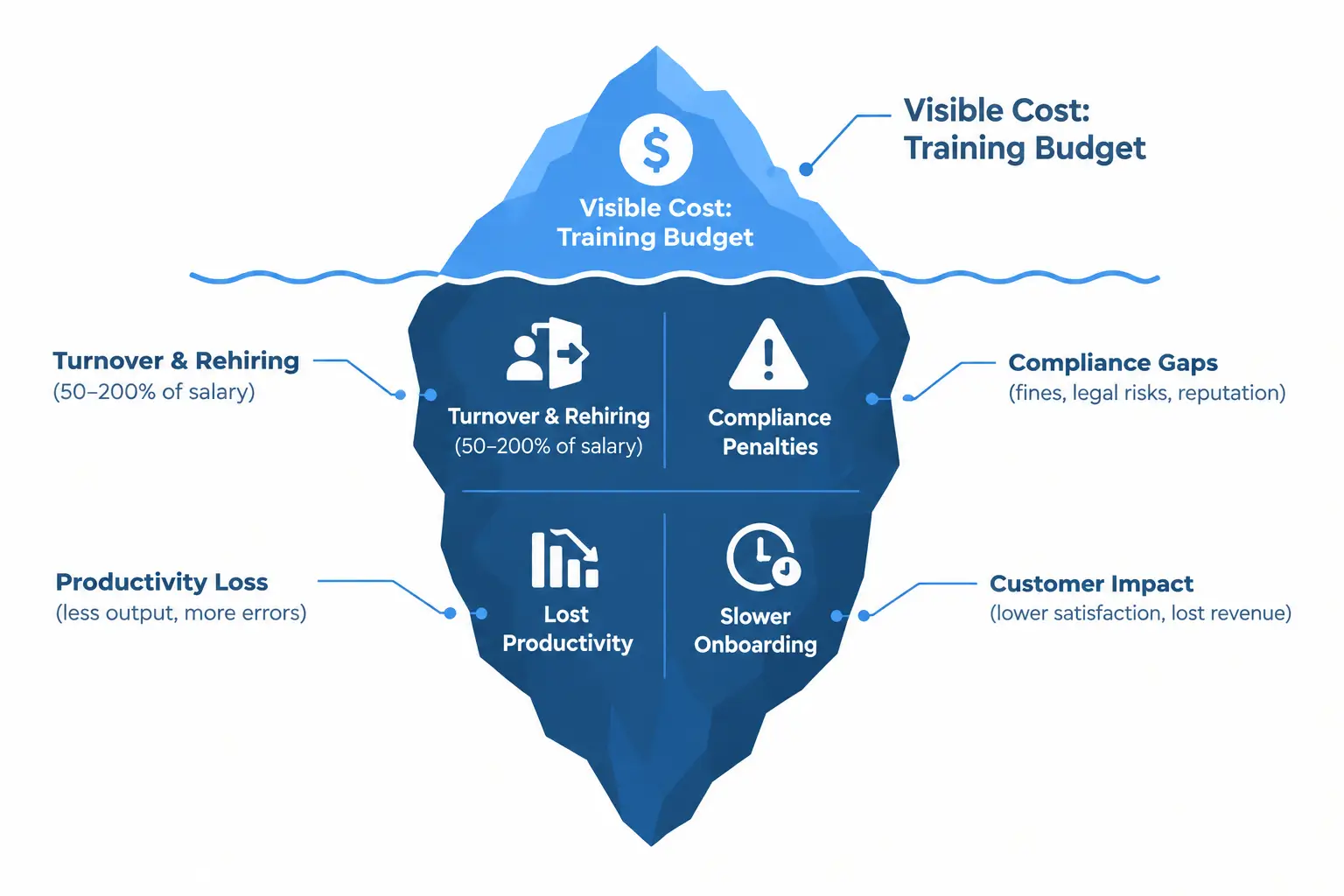
Every conversation about training ROI focuses on what training costs. The more important number is what skipping it costs.
Replacing an employee costs an estimated 50 to 200% of their annual salary, depending on the role and industry. That figure includes recruiting, onboarding, lost productivity during the transition, and the institutional knowledge that walks out with the departing employee.
If training reduces turnover by even 5 to 10 percentage points in a 50-person team, the savings outrun the training budget before the end of the year. Gallup’s data shows the companies with strategic development programs are twice as likely to retain staff. The math on that retention delta is almost always favorable.
Compliance gaps carry separate costs. In regulated industries — healthcare, finance, food service — inadequately documented training is a legal and operational liability. A missed certification is not just an HR problem; it is an audit finding.
Online Training vs. In-Person Training: When Each Makes Sense
Online training is not the right tool for every situation. Here is a direct comparison:
|
Situation |
Best approach |
|
Compliance training with documented completion |
Online — LMS provides the audit trail |
|
Technical onboarding with system walkthroughs |
Online — self-paced, repeatable |
|
Sales skills, role plays, or negotiation practice |
In-person — requires real interaction |
|
Scaling new content to 50+ employees at once |
Online — no scheduling or travel costs |
|
Building team culture or values |
In-person or blended — human connection matters |
|
Product knowledge updates for distributed teams |
Online — one-time build, instant rollout |
|
Leadership development programs |
Blended — coaching and feedback require presence |
The default for most knowledge-based training is online. The exception is training where the skill itself requires human interaction to develop.
How to Start an Online Training Program on WordPress
If you run a WordPress site, you already have the infrastructure for online employee training. You need to add two things: courses and tracking.
Academy LMS installs as a WordPress plugin and adds a full course builder, learner enrollment, quiz engine, progress tracking, and certificate generation to your existing site. Your employees get a dedicated learner dashboard. You get an admin view of exactly who completed what and when.
For businesses with a distributed team, contractors, or part-time staff, this setup removes the per-seat subscription cost of a hosted LMS platform. You build the course once, enroll as many people as needed, and the LMS tracks everything automatically.
If you are still evaluating which platform fits your needs, see our guide on how to choose the right LMS.
Decision Framework
Frequently Asked Questions
What are the main benefits of online training for employees?
The most measurable benefits are lower training costs (40 to 60% less time than in-person), higher employee retention (companies with strategic L&D are twice as likely to retain staff, per Gallup), consistent quality across all locations, and automated tracking of completion and performance. The benefit that most organizations underestimate is the data — knowing exactly who completed what and how they scored allows you to improve training over time.
How much does online employee training cost?
The cost depends heavily on the delivery platform. An LMS plugin for WordPress costs $100 to $300 per year. Hosted SaaS platforms range from $59 per month to $500 or more depending on the number of learners. Enterprise contracts start at $15,000 per year. For a full breakdown, see our LMS cost and pricing guide.
Is online training as effective as in-person training?
For knowledge-based training — compliance, product knowledge, technical onboarding, process documentation — online training is at least as effective and often more so, because employees can learn at their own pace and revisit material as needed. For skill-based training that requires human interaction, such as leadership coaching or sales role plays, in-person or blended approaches are more effective.
How do you track employee training completion online?
An LMS tracks completion automatically. When an employee finishes a course and passes the required assessment, the system records the completion date, the score, and generates a certificate if configured. Admins can pull reports for any employee, course, or time period without manual follow-up.
What types of training work best online?
Compliance and certification training, new hire onboarding, product and system walkthroughs, soft skills courses, and any training that needs to reach a distributed team consistently. Training that depends on real-time human interaction — coaching, role-plays, group workshops — works better in person or in a live virtual format.
How does online training help employee retention?
The connection is direct: employees who feel the organization is investing in their development are less likely to leave. Gallup’s research shows companies with strategic development programs are twice as likely to retain their people. For smaller organizations that cannot compete on salary alone, a clear and accessible learning path is one of the most effective retention tools available. See our guide on the LMS vs CMS difference for why purpose-built training software matters more than improvising with a general website platform.
Can small businesses afford online employee training?
Yes. The main cost is the platform. A WordPress LMS plugin eliminates per-seat pricing entirely — you pay a flat annual fee regardless of how many employees enroll. For small teams, that math is significantly better than a per-user SaaS subscription that compounds as the team grows.