









Shopify is easy to get started with. That much is undeniable. You sign up, pick a template, connect a payment processor, and you can technically have an online store running in an afternoon. For a lot of people — especially those building their first ecommerce website — that ease of setup is genuinely valuable.
But here is the thing: Shopify’s simplicity comes with a price tag that grows alongside your business. The monthly pricing starts at $39 per month on the Basic plan, climbs to $105 for Standard, and hits $399 per month at Advanced. Add the transaction fee (if you are not using Shopify Payments), the cost of third-party apps from the Shopify app store for features that should arguably be included, and the limited customization you actually have over your store’s checkout and business logic — and the picture looks quite different from the friendly onboarding experience.
That is why so many business owners start searching for a shopify alternative once their store gets serious. Whether you are looking for lower costs, more control, better SEO capability, or the freedom to truly sell products the way your business model demands — there are strong options. This guide breaks down the best shopify alternatives available right now, what each one is genuinely good at, and how to make the right call for your situation.
Why Business Owners Consider Shopify Alternatives
Before we explore the best options, let’s be direct about why so many shopify merchants go looking for alternatives. This is not about Shopify being a bad platform — it is about recognizing specific gaps that become more painful as your online business grows.
1. The Monthly Fee Model Never Stops Growing
Shopify’s pricing is subscription-based: you pay every single month, forever. On top of that, most serious stores end up spending $50–$300+ per month on third-party app subscriptions for features like subscriptions billing, memberships, advanced checkout, and proper marketing tools. That spending never ends, and it scales up as your store grows.
2. Platform Lock-In Is Real
When you switch from shopify, it is genuinely painful. Your store data, product listings, customer records, and integration configurations are all inside Shopify’s walled garden. You are renting the platform, not owning it — and that distinction matters more and more as your ecommerce business becomes your primary revenue source.
3. Customization Has Hard Ceilings
Shopify’s customization is good within its constraints, but those constraints are real. Shopify’s Liquid templating system is not as flexible as building on WordPress or a true open-source platform. Checkout customization — one of the highest-leverage areas for conversion optimization — is locked unless you are on Shopify Plus, which starts at $2,300/month.
4. The Transaction Fee Is a Persistent Tax
If you are outside of Shopify Payments’ supported countries or prefer a different payment processor, Shopify charges a transaction fee on every single sale — 0.5% to 2% depending on your plan. On a high-volume store, that compounds into a meaningful cost that never goes away.
| THE BOTTOM LINE Most small businesses that stay on Shopify for 3+ years end up paying $3,000–$8,000 per year in platform fees, app subscriptions, and transaction costs. Cheaper than shopify alternatives exist — and many offer more control. |
5 Best Shopify Alternatives in 2025
1. StoreEngine — Best Shopify Alternative for WordPress Users
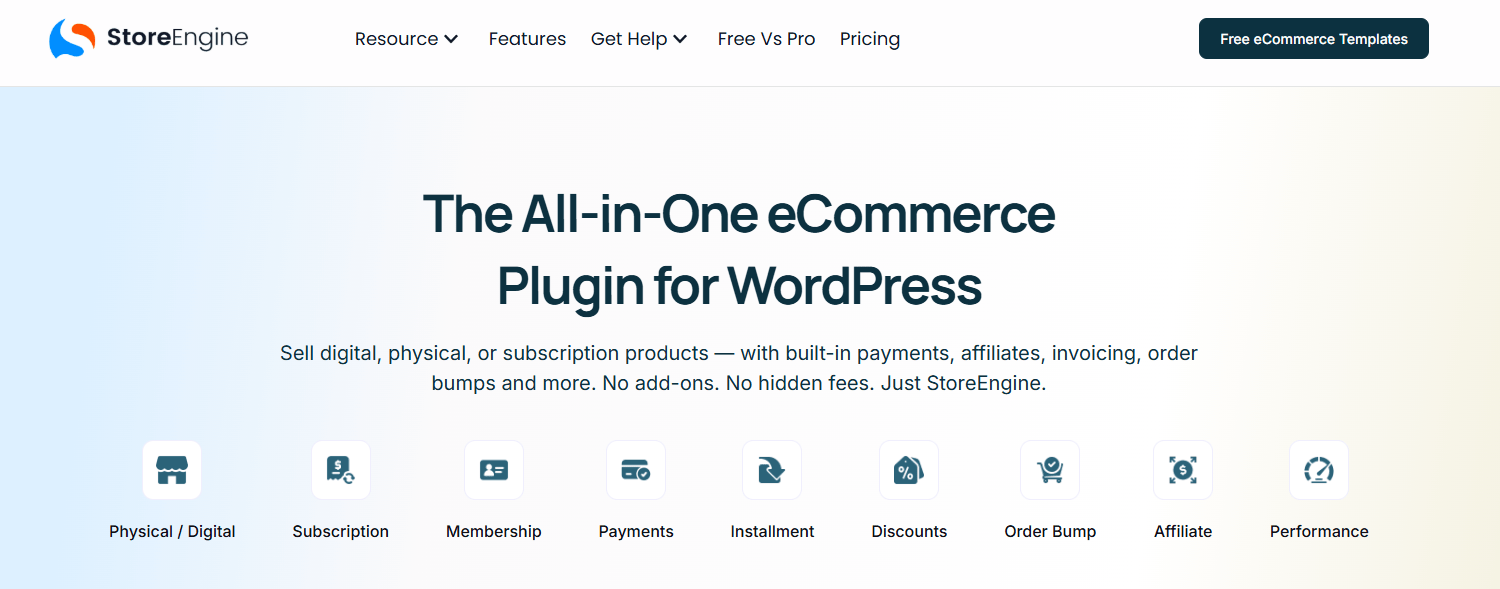
If your site runs on WordPress — or you are open to building on it — StoreEngine is the most compelling shopify alternative available right now. It is an all-in-one ecommerce platform built as a WordPress plugin, and it approaches commerce from a completely different philosophy than Shopify: you own everything. Your store. Your data. Your checkout logic. Your business rules.
Where Shopify requires a third-party app for subscriptions, another for memberships, another for order bumps, and another for custom checkout flows, StoreEngine has all of that built in natively. Subscriptions, memberships, license management, installment payments, abandoned cart recovery, Google Tag support, and Meta Pixel integration — included. Not extra.
The ease of use is genuinely impressive for a WordPress plugin. The admin interface is React-based, meaning it is fast and modern — closer to a standalone app than a traditional WordPress dashboard. The learning curve is short, especially for anyone already comfortable with WordPress.
For small businesses that want to sell products — physical goods, digital products, courses, software, or memberships — without the escalating monthly expense of Shopify, StoreEngine offers a flat annual license structure starting at around $99/year. A one-time lifetime license option is also available for around $319. No transaction fee. No platform percentage cut. No forced integration tax.
The SEO advantage of being WordPress-native is also real. WordPress is the most SEO-friendly CMS in the world, and StoreEngine stores inherit all of that — free plan WordPress SEO plugins, schema markup, full URL control, and content-driven marketing tools that Shopify cannot match at the same price point.
|
Factor |
StoreEngine |
Shopify (Basic) |
|
Platform type |
WordPress plugin (self-hosted) |
Hosted SaaS |
|
Monthly fee |
None |
$39/month |
|
Annual cost (est.) |
~$99/yr + hosting |
$468/yr + apps |
|
Transaction fee |
None |
2% (without Shopify Payments) |
|
Subscriptions |
Built-in |
Paid app required |
|
Memberships |
Built-in |
Paid app required |
|
Checkout control |
Full |
Locked (Plus only) |
|
Sell digital products |
Built-in |
Limited |
|
SEO control |
Full (WordPress) |
Moderate |
|
Customization |
Unlimited (PHP/JS/CSS) |
Liquid-restricted |
|
Data ownership |
100% yours |
Platform-restricted |
|
Unlimited products |
Yes |
Yes |
| BEST FOR WordPress users, digital product sellers, subscription businesses, small businesses, and anyone who wants full store ownership without monthly platform fees. Perfect for small businesses that want a powerful, low-cost alternative to Shopify. |
2. BigCommerce — Best Shopify Alternative for High-Volume Stores

When comparing Shopify or BigCommerce for a scaling business, BigCommerce often wins on raw ecommerce features. It is a hosted ecommerce platform that packs more into its base plans than Shopify does — and critically, it charges no transaction fee on any plan regardless of which payment processor you use. For high-volume stores, that alone can save thousands per year.
The ecommerce features are extensive: multi-currency, multi-channel selling, B2B quoting, detailed SEO controls, and advanced product filtering are all included without extra app purchases. You can sell unlimited products on every plan, which is a genuine advantage over platforms that restrict 500 products at lower tiers.
The main limitation is that BigCommerce’s pricing is tied to your annual sales volume. Hit certain revenue thresholds and you get pushed to a higher-cost business plan automatically — which creates an unpredictable cost structure as your ecommerce business grows. The template selection is also smaller than Shopify’s, and while customization is reasonably open, it still does not match the freedom of a WordPress-native solution.
The wix vs shopify debate often leaves out BigCommerce entirely — but for business owners operating at serious volume, it arguably beats both. Plans start at $39/month.
| BEST FOR High-volume stores, B2B sellers, and businesses that need no-transaction-fee processing with more built-in features than Shopify offers at the same price tier. |
3. WooCommerce — Best Free Open-Source Shopify Alternative
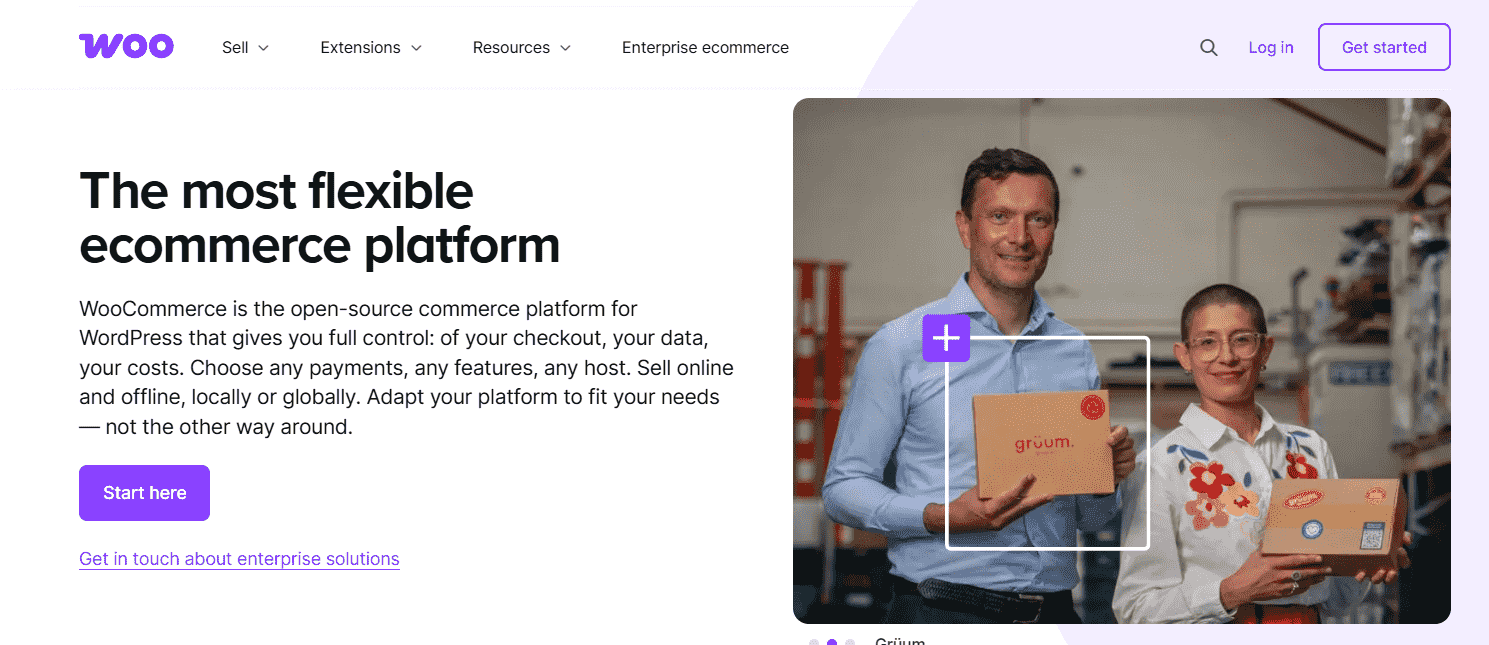
WooCommerce is the most widely used ecommerce platform in the world, powering roughly 37% of all online stores. It is a free plugin for WordPress — and woocommerce is a free solution built for small businesses and individual sellers who want a zero-cost starting point on an open-source platform. If you are looking for a best free shopify replacement that gives you real commerce functionality without any upfront cost, WooCommerce is the most obvious answer.
The woocommerce alternative to shopify argument is strong on paper: you own your store, you control your data, there is no platform fee, and the plugin ecosystem is enormous. But WooCommerce’s free core handles only the basics. Nearly every advanced feature — subscriptions, memberships, custom checkout, advanced marketing tools — requires a paid extension. The total cost for a fully featured WooCommerce store often lands between $600–$900 per year in extensions alone, before hosting.
For small businesses that want maximum control and are comfortable managing plugins and updates, WooCommerce remains one of the most powerful options. But if you want that same WordPress ownership without the extension overhead, StoreEngine is a newer, cleaner alternative built specifically to solve WooCommerce’s plugin-stacking problem.
| BEST FOR WordPress-comfortable sellers who want a free starting point and are willing to invest time managing extensions and updates. Get started for free — but budget for extensions as you grow. |
4. Wix — Best Shopify Alternative for Simple, Visual Stores
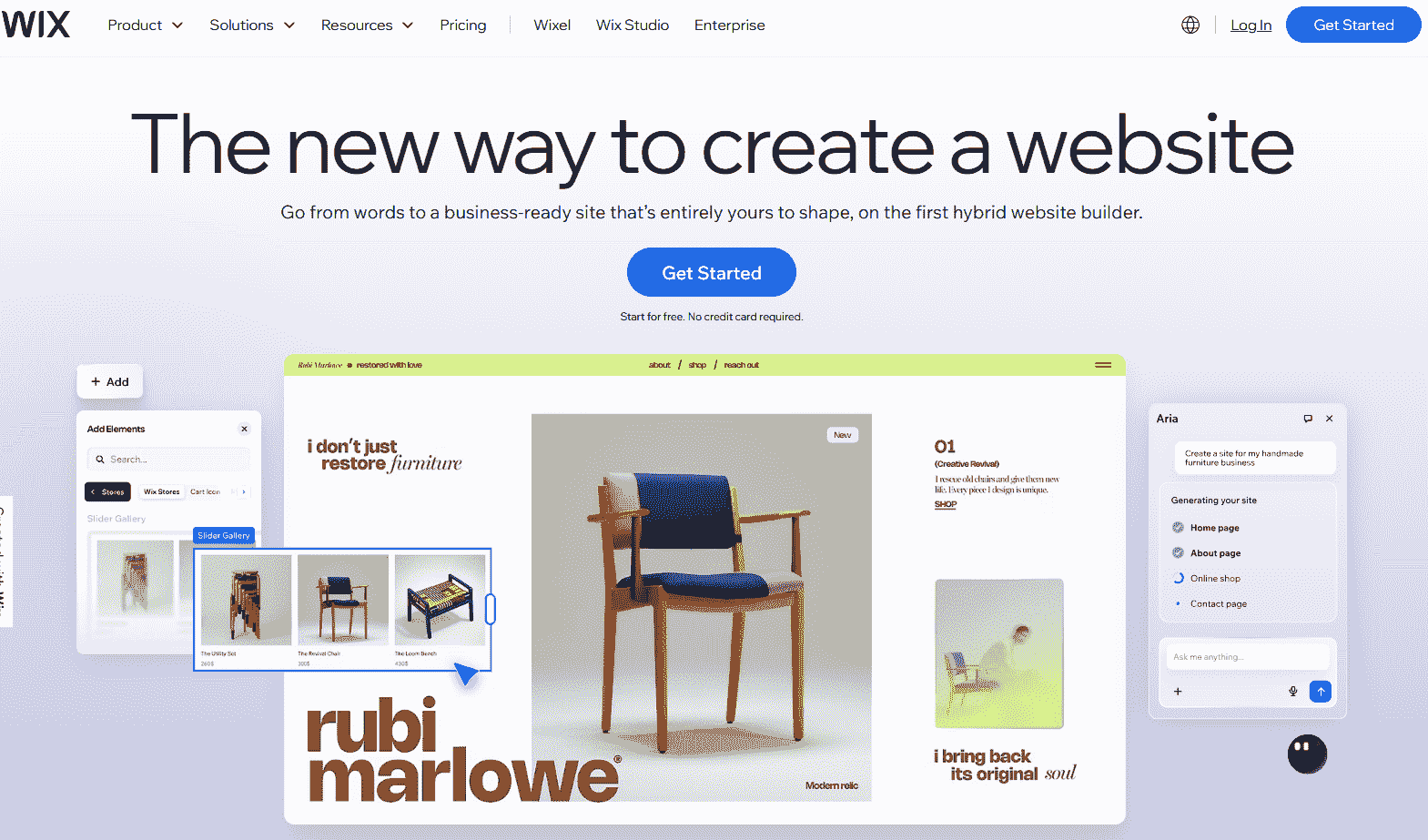
Wix has evolved from a basic website builder into a surprisingly capable online store builder for small businesses. The visual editor is one of the most intuitive in any ecommerce platform — drag-and-drop layout control, a large free theme library, and highly visual customization make it genuinely accessible for people who want a good-looking store without coding. The ease of use rivals Shopify, and for many use cases it is actually simpler to get started.
Wix offers a free plan for building a site, though you will need a paid plan to actually sell products. E-commerce plans start at around $17/month — making it genuinely cheaper than shopify at the entry level. It supports digital products, physical goods, and basic subscription products. Integration with payment processors including PayPal and Stripe is straightforward.
Where Wix falls short is at scale. Advanced inventory management, complex product customization, deep SEO control, and serious marketing tools all hit limitations quickly. And like Shopify, it is a hosted platform — you do not own your store infrastructure, and migrating away is difficult. The learning curve is low, but so is the ceiling.
| BEST FOR Small businesses and solo sellers who want an easy, visually-driven store with minimal setup complexity. Ideal for stores with simple catalogs and moderate traffic. Offers a free plan for website building. |
5. Squarespace — Best Shopify Alternative for Creatives and Brand-First Sellers

Squarespace is the gold standard for design quality in the website builder space. Its template library is genuinely beautiful — clean typography, elegant layouts, and strong mobile responsiveness come standard with every theme. For photographers, artists, designers, and brand-driven small businesses, no other platform makes it easier to look professionally credible from day one.
Its ecommerce features have improved significantly. Commerce plans (starting around $23/month) include no transaction fee, the ability to sell digital products, subscription products, abandoned cart recovery, and integration with major payment processor options. The SEO tooling is solid at the basics — meta fields, alt text, clean URL structures — though it does not match the depth of a WordPress-native store.
The limitation is the same one Squarespace has always had: it prioritizes design consistency over flexibility. Deep customization is constrained, the third-party app ecosystem is thin compared to Shopify or WordPress, and it is not a good fit for stores with complex product catalogs or advanced business logic. The online business it suits best is the one where aesthetics lead and simplicity is a feature, not a limitation.
| BEST FOR Creatives, photographers, boutique brands, and sellers with curated catalogs who want the most visually polished store possible with minimal setup. Good option if design matters more than deep feature depth. |
Top Shopify Alternatives at a Glance
|
Platform |
Type |
Starting Price |
Best For |
|
StoreEngine |
WordPress Plugin |
~$99/yr (no monthly fee) |
WP stores, digital products, full control |
|
BigCommerce |
Hosted Builder |
$39/month |
High-volume, B2B, no transaction fees |
|
WooCommerce |
WP Plugin (OSS) |
Free + extensions |
Open-source, tech-comfortable sellers |
|
Wix |
Hosted Builder |
$17/month |
Simple, visual, entry-level stores |
|
Wix |
Hosted Builder |
$23/month |
Creatives, brand-first sellers |
Choosing the Right Platform: A Decision Framework
There is no single “best” shopify alternative — there is the right one for your specific situation. Here is a clear framework for deciding:
Stay on WordPress or build on it?
• Want full ownership + all-in-one built-in features: StoreEngine
• Want free open-source with maximum plugin flexibility: WooCommerce
Prefer a fully hosted platform?
• Need the most built-in features and no transaction fees at scale: BigCommerce
• Want the easiest setup and largest app ecosystem: Shopify (if budget allows)
• Want strong design with simple commerce needs: Squarespace
• Want the lowest entry price and visual ease: Wix
Selling mostly digital products?
• On WordPress: StoreEngine (built-in digital delivery and licensing)
• Off WordPress: Squarespace Commerce or BigCommerce both handle digital well
Small business owners on a tight budget?
• Cheapest overall with full features: StoreEngine (~$99/yr, no monthly fee)
• Free starting point: WooCommerce (free plugin, pay for hosting only)
• Cheapest hosted option: Wix ($17/month with commerce)
| The right ecommerce platform is not the most popular one — it is the one that fits your business model, your budget, and your growth plans.— StoreEngine, 2026 |
A Note on SEO and AI Search in 2026
One dimension that does not get enough attention in these comparisons: SEO. In 2026, with AI-driven search results pulling content directly into answers, the platform you choose has a direct impact on how visible your online business is — not just in traditional search, but in AI-generated responses from tools like ChatGPT, Perplexity, and Google’s AI Overviews.
Shopify’s shopify SEO capabilities are decent but constrained. URL structures, canonical tags, and schema markup are managed within Shopify’s system, giving you limited flexibility. Squarespace and Wix have improved significantly but still trail behind WordPress-native stores in technical SEO depth.
WordPress — whether running WooCommerce, StoreEngine, or any other plugin — gives you more complete control over every SEO signal: structured data, schema markup, Core Web Vitals optimization, full sitemap customization, and content-driven authority building. For businesses where organic traffic and AI citation are a meaningful part of the growth strategy, staying on WordPress is a genuine competitive advantage.
| 2026 SEO REALITY Platforms that give you full control over structured data, schema markup, and page speed optimization consistently outperform locked hosted platforms in AI-powered search results. WordPress-native stores have a measurable advantage here. |
Final Thoughts: Choose the Platform That Fits Your Business
Shopify built its reputation on making it easy to get started for free with a trial and get a store live quickly. That remains true. But “easy to start” and “right for the long term” are two different things — and for a growing number of business owners, the math simply stops working in Shopify’s favor as the monthly fees, transaction fee costs, and third-party app subscriptions pile up.
The best shopify alternative for your online business is the one that matches your business model, your technical comfort level, and your five-year growth plan — not just your first month. If you are a WordPress user or creator who wants full ownership and all-in-one functionality, StoreEngine is worth a serious look. If you need a no-transaction-fee hosted platform at volume, BigCommerce delivers. If design is your lead, Squarespace is excellent. And if you want to get started for free on a truly open ecommerce solution, WooCommerce still delivers that better than anything else.
Take the time to explore shopify alternatives before assuming the most well-known platform is the right one. In most cases, there is a right platform that fits your business better — and finding it before you are locked in will save you real money and real headaches down the road.
Frequently Asked Questions
What is the best free Shopify alternative?
WooCommerce is the most popular free Shopify alternative — it is a free WordPress plugin that lets you sell unlimited products with no platform fee. StoreEngine also offers a free core tier. Both require you to pay for your own hosting, but neither charges a monthly platform subscription.
What is the cheapest Shopify alternative for small businesses?
StoreEngine is the cheapest full-featured alternative at around $99 per year for an annual license — with no monthly fee, no transaction fee, and no platform percentage. Wix starts at $17/month for ecommerce, which is cheaper than Shopify’s $39/month Basic plan. WooCommerce is free to install but requires paid extensions for advanced features.
Is BigCommerce better than Shopify?
For high-volume stores, BigCommerce is often the better choice — it charges no transaction fees, includes more features at the base plan level, and handles large catalogs well. For simplicity and the largest app ecosystem, Shopify still leads. The best choice depends on your volume, feature needs, and tolerance for monthly costs.
Can I switch from Shopify to WordPress?
Yes. Migrating from Shopify to a WordPress-based platform like StoreEngine or WooCommerce is possible and well-documented. You can export your product and customer data from Shopify and import it into WordPress. StoreEngine’s support team and documentation provides migration guidance for store owners making the switch.
Does Wix allow selling unlimited products?
Wix allows unlimited products on its Core and higher ecommerce plans ($29/month and above). The base Business plan at $17/month has some limitations. This is more generous than some competitors that restrict product counts at entry-level tiers.
Which Shopify alternative is best for selling digital products?
StoreEngine is the strongest option for digital products on WordPress — it includes built-in secure file delivery, license management, and digital download controls without any extra plugin. Squarespace Commerce and BigCommerce also handle digital products well on hosted platforms.
Is Squarespace a good Shopify alternative for small businesses?
Squarespace is a good fit for small businesses where design quality and simplicity are the priority. It has no transaction fees on Commerce plans, handles basic product types well, and is easier to use than Shopify for non-technical sellers. It is not ideal for stores with complex catalogs, advanced customization needs, or high product volumes.